
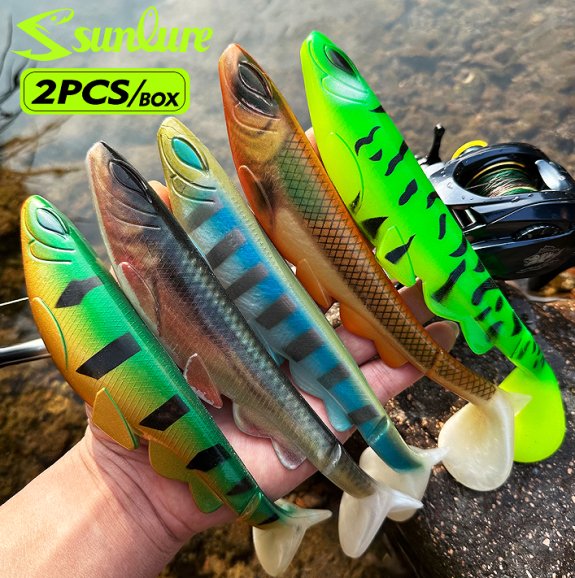
Ask five pike anglers which tail shape they trust and you will get five answers. The honest one is: both catch fish, and they catch them under different conditions. Understanding why turns a coin flip into a decision.
What each tail actually does
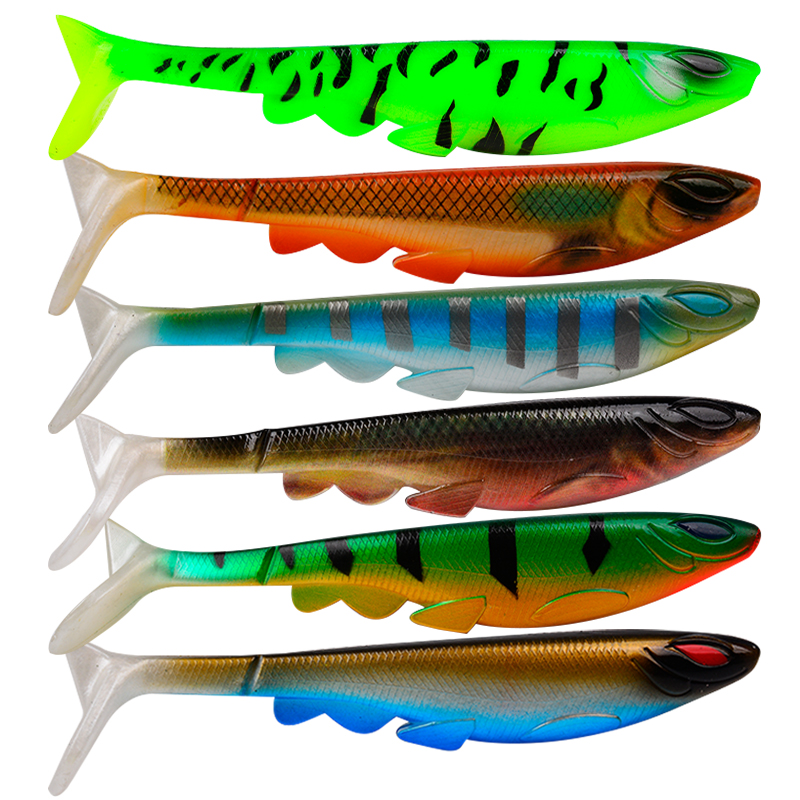
Paddle tail (SL1002). A wide, flat tail that swings side to side and pushes a lot of water. You feel it in the rod handle as a steady thump. It works at very slow speeds, which is why it wins in cold water and over deep structure where you need to keep the bait down without racing it back.
Fork tail (SL1011). A narrow V that gives a tight shimmy on the retrieve and a hard dart when you twitch. It is the more erratic, more "fleeing" profile - and it sinks faster for its size.
Pick the paddle tail when...
- The water is cold (below 10°C) and pike will not chase - the tail works at a crawl.
- You are fishing deep (6 m and beyond) and need maximum vibration to be found.
- The water is coloured or murky. Vibration travels further than sight.
- You want to cover water with a steady, rhythm-free retrieve that does not demand constant rod work.
Pick the fork tail when...
- Fish are following but not committing - the dart on the pause is the classic follower trigger.
- You are fishing shallow weed or timber and need a bait that slips through instead of bulldozing.
- Baitfish in the lake are slim-profile (roach, rudd, smelt) rather than deep-bodied.
- You are working vertically from a boat and want a fast, controlled sink.
The retrieve difference in one sentence
Paddle tail: cast, count down, and reel as slowly as you can while still feeling the thump. Fork tail: cast, count down, then lift-fall or twitch-pause and strike on the drop.
Sizes that matter
| Model | Size | Length | Weight | Per pack |
|---|---|---|---|---|
| SL1002 paddle tail | N15 | 15.2 cm / 6 in | 26.5 g | 2 pcs / box |
| SL1002 paddle tail | N20 | 20.3 cm / 8 in | 70 g | 2 pcs / box |
| SL1011 fork tail | N68 | 13 cm / 5.1 in | 68 g | 2 pcs |
| SL1011 fork tail | N103 | 15 cm / 5.9 in | 103 g | 2 pcs |
Rule of thumb for pike: 6 in for numbers, 8 in for size. If you only carry one, carry the 6 in - it gets bitten more often, and a 6 in bait still catches double-figure fish.
Rigging both
Both bodies run best on a jig head or a belly-weighted screw-in hook matched so the bait sits level in the water. Too light a head and the bait rises and twists; too heavy and the tail action tightens into a wobble. For the SL1002 N15, start with a 7-10 g head; for the N20, 14-21 g.
Always use a wire or heavy fluorocarbon leader. Pike bite through 20 lb mono without noticing.
Who should buy which
- Beginner, one lure, cold water: SL1002 paddle tail in N15.
- Experienced angler chasing a personal best: SL1011 fork tail in N103 or N277.
- Boat angler with electronics: both - paddle tail for marking fish, fork tail for converting followers.
Try both
They are not competing purchases, they are two tools. Paddle tail SL1002 → Fork tail SL1011 →
Comments (0)
No comments yet. Landed a fish on this lure? Tell us where and how.